
Ask this Question to ourselves:
What do God and Religions want?
Misinterpreting and misusing the message of God and Religion for the lustful pursuit of personal gain; by becoming a self-appointed agent of God and religion for enjoying leading people by dividing them in camps; inflaming chauvinism finally to lead humanity to war, destruction, holocaust, and sufferings… Sadly, exactly opposite to the teachings and generally pronounced purpose of God and Religion.
How is Religion ‘misused’?
Religion is commonly misused as a tool for power, control, and division rather than its intended spiritual purpose. It is often weaponized to justify violence, enforce harmful ideological conformity, manipulate followers for financial or personal gain, and to belittle, diminish in value or importance, vilify and demonize other groups.
.Ways religion is misused
Throughout history, and even today, religious doctrine has been invoked to justify wars, terror, and violence (e.g., The Crusades, Religious extremism).
Leaders may use religious authority to twist scriptures, creating fear (Spiritual Abuse), or demanding strict obedience to gain personal power or financial gain.
Religion is frequently used to justify prejudice against LGBTQ+ individuals, minority groups and women, thus promoting hate and discrimination.
Religious dogma is used to reject scientific facts (e.g., evolution, medical treatments) so impeding scientific progress, or to block social or societal change.
Misuse of doctrine to cultivate “us vs. them” mentalities, glorifying conflict and suppressing dissent within communities.
These abuses often revolve around using ‘faith’ to mask selfish, deceitful or harmful agendas, or to enforce damaging and detrimental societal controls.
Jeffrey F. Addicott, St. Mary's University, writes, “A brief review of human history reveals that various individuals, groups and nations have used religious dogma as a pretext to engage in aggression against others. As such, it is no surprise that the Islamic radicalism that fuels the Global War on Terrorism employs what it calls the “true” Moslem religion in order to cloak a lust for domination through despicable expressions of unlawful violence, primarily targeting innocent civilians.” [1]
Example: In the past:
Sati or suttee Tradition of burning alive the widow at the funeral pyre of her husband

Sati (also called suttee) is the practice among some Hindu communities by which a recently widowed woman, either voluntarily or by use of force or coercion, commits suicide as a result of her husband's death. The best known form of sati is when a woman burns to death on her husband's funeral pyre.
Example: The present day:
Female genital mutilation (FGM)

Female genital mutilation (FGM) is the partial or total removal of external female genitalia for non-medical reasons. It's also known as female circumcision or cutting.
Religious, social or cultural reasons are sometimes given for FGM. However, FGM is child abuse. It's dangerous and in many countries now a criminal offence.
There are no medical reasons to carry out FGM. It doesn't enhance fertility and it doesn't make childbirth safer. It is used to control female sexuality and can cause severe and long-lasting damage to physical and emotional health.
Does Religion require Blind Obedience
Religious belief does not inherently require “blind faith” – defined as belief without evidence or against reason – though it is often perceived that way. Instead, many religious traditions view faith as a “reasoned trust” or confidence built on evidence, experience, or tradition, rather than a total absence of evidence.
Here are some key aspects regarding the relationship between faith and evidence:
Evidential Faith: Many believers argue that faith is a response to evidence, such as historical testimonies, philosophical arguments, or personal experience. Thomas Aquinas formulated five logical arguments, known as the “Five Ways” (Quinque Viæ), to demonstrate God's existence in his 1274 book Summa Theologica.
Distinction from “Blind Faith”: Blind faith involves ignoring contradictory evidence or trusting without justification. Conversely, many faiths emphasize “testing” and/or understanding, such as the command in Christianity to ‘love God with the mind’.
Faith in the Unseen: While Scripture (e.g., Hebrews 11:1) speaks of faith as “the conviction of things not seen”, proponents argue this means trusting in God's demonstrated faithfulness, not blindly believing in the absurd.
Different Definitions: The misunderstanding often arises from different definitions of “faith”. While some interpret it as a “leap in the dark&rdquol, others see it as a confident step based on reasoned trust.
While some interpretations of religion emphasize absolute, uncritical obedience, many others view it as a reasoned, trusting relationship that engages, rather than abandons, the intellect.
Read more at United Global Human.org:-
Article - Misuse of Religion
The impulse to believe what we want to believe.
The impulse to believe what we want to believe is a, often subconscious, cognitive process driven by the desire for comfort, validation, or emotional stability rather than
objective truth. Driven by ‘confirmation bias’, individuals selectively accept information validating views and beliefs while skeptically scrutinizing facts that cause
discomfort, allowing emotions to dictate reality.
While this impulse can boost morale, help build a positive future vision, or offer mental peace, it can lead to the formation of false beliefs, susceptibility to misinformation,
and a refusal to acknowledge reality.
Is belief in Religion and Science mutually exclusive?
Belief in science and religion is generally not considered to be mutually exclusive, and many individuals and scholars view them as complementary, addressing different aspects of human experience — science explores the “how” of, for example, the physical universe, while religion often explores the “why”. They are considered distinct but not necessarily conflicting domains of understanding.
Coined by Stephen Jay Gould, ‘Non-overlapping Magisteria’ suggests that science deals with the empirical, natural world, while religion handles spiritual meaning and morality, meaning they do not need to clash. As a public advocate for science he campaigned against creationism and proposed that science and religion should be considered two distinct fields (or “non-overlapping magisteria”) whose authorities do not overlap.
Many scientists are religious and see their scientific research as a way to understand the complexity and beauty of creation, arguing that science and faith can coexist or even reinforce
each other.
Some argue that historically, many scientific advancements were made by people of faith, and that the empirical methods of science and the subjective, ethical focus of religion serve
different, non-contradictory needs.
Some, however, view them as inherently incompatible, arguing that science is based on empirical, testable evidence, while religion is based on 'untestable' faith, with some believing religion offers no tangible progress toward understanding reality.
Many major scientific breakthroughs were made by individuals with religious backgrounds, for example, Gregor Mendel (Genetics) who was a Catholic Priest. Different religions interact with science in various ways, with many modern religious scholars finding no conflict with science, while others hold more traditional interpretations.
Ultimately, whether they are seen as exclusive often depends on whether one interprets religious texts literally, particularly regarding subjects that contradict scientific finding
Read more here: We Believe What We Want to Believe
“The human understanding when it has once adopted an opinion...draws all things else to support and agree with it.”
Francis Bacon (22 January 1561 – 9 April 1626) English philosopher, statesman, scientist
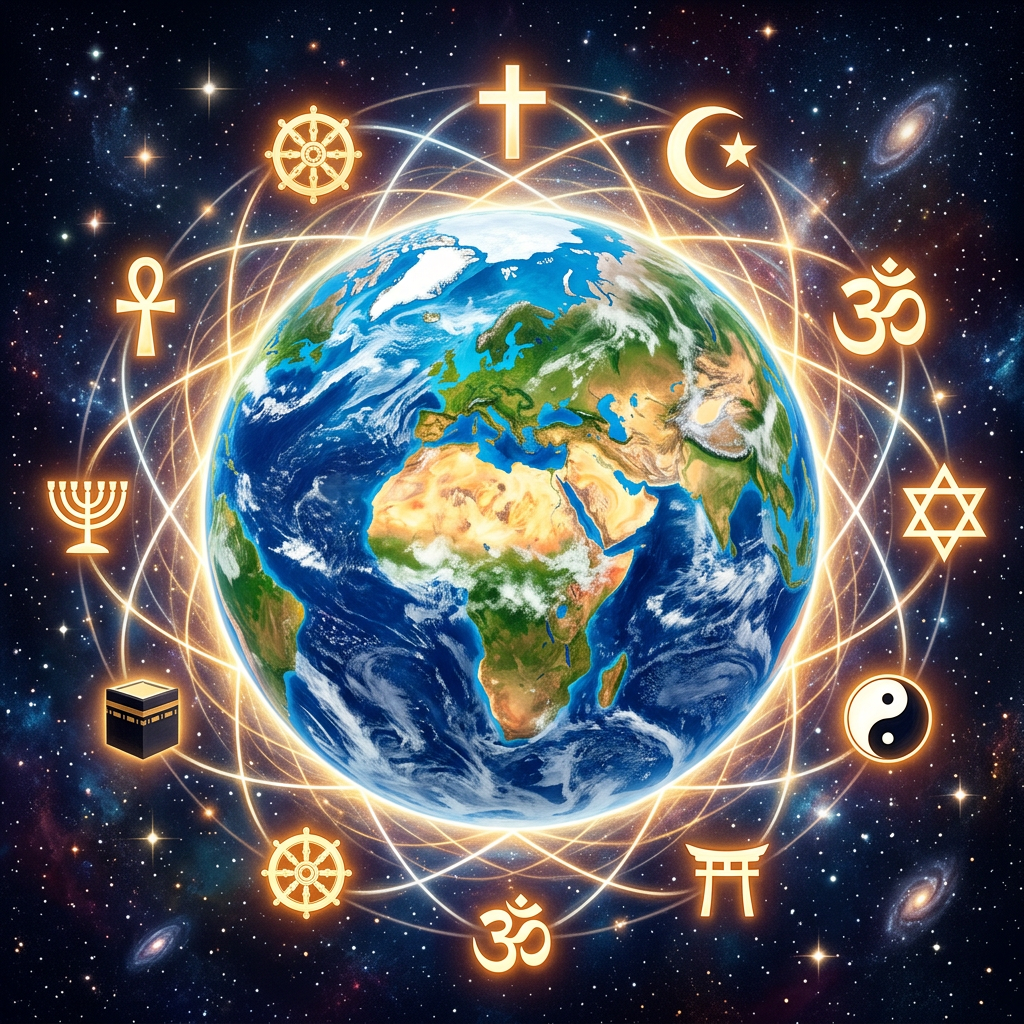
World Religions and beliefs
Humanity appears (simplistically) to be divided into four schools of thought,
the believers in Religion,
the believers in Science,
the believers in both Religion and Science, and
those who do not believe in religion or science.
There are many people throughout the world who claim that the Religious believers only are the correct thinkers. On the other hand the believers only in Science (Scientism) and who dismiss Religion assert that they are the correct thinkers.
This polarization of thought has over millennia lead to conflicts of one form or another in both camps ranging from dismissive actions and language to physical violence, persecution, imprisonment, exile, genocide and global conflict.
Many devout followers of Religion are dismissive of those that espouse science, pointing to a supreme being as the answer to all questions. Their God provides them with the moral code of ethics that dominates their thinking and their way of living.
Equally there are many that follow only science who denounce devout religious people, and their belief in God, as merely fanatics who would resist the ‘march of progress’
to the detriment of the World and Humanity.
These followers of 'Scientism' believe that the only kind of knowledge humanity can have is scientific.
Most religions espouse Peace
It is undeniable that [most] Religions espouse Peace, harmony, tolerance and understanding in their teachings. Our question then is this, “Why then do Religious zealots go to war to prove that they and their 'God' are more peaceful, harmonious, tolerant, and understanding than other religions or people?”
Meanwhile, the followers of Science will point their fingers at the religious zealots and decry their actions whilst relentlessly pushing Science as the only true way to Peace,
harmony, tolerance, and understanding.
At the same time many 'Scientismists' take scientific knowledge and use it to help make products that ultimately prove harmful, to the World and Humanity, in the name of furtherance
of Science.
So, what about those people who believe in Religion and Science. Where do they fit in with our model of thinkers?

"Science without religion is lame, religion without science is blind."
Albert Einstein
There have been, over the years, many that have pushed, and that continue to push, the boundaries of human knowledge, learning, and thinking through Science, and the humanities, whilst following a moral code of ethics. Their moral code is that Science should be used for the promotion of Peace, harmony, tolerance, and understanding in line with their religions teachings and beliefs.
Einstein understood that scientific knowledge cannot be the only kind of knowledge, and that it must necessarily interact with religious/philosophical reasoning when he said, "Science without religion is lame, religion without science is blind."
Another invaluable contributor to modern science ... Max Planck (the Nobel Prize winning physicist who first proposed quantum theory), said, “There can never be any real opposition between religion and science; for the one is the complement of the other.”
Misuse of Science
The main goal of science is to produce accurate, evidence-based knowledge and understanding. It achieves this by describing, predicting, and explaining phenomena, ultimately allowing for the creation of models that help explain how, for example, the universe functions, and is often applied to solve practical problems.
Lisa Rosenbaum, M.D., in her article, The March of Science - The True Story writes, “But the topics on which scientific consensus is rejected are many, ranging from organic food's lack of nutritional superiority to alternative medicine's many unproven benefits. Though people may trust science in the abstract, when faced with facts they don’t want to believe, they seek to “prove” that the process that generated those facts is untrustworthy.”
Read this article published in the New England Journal of Medicine
The March of Science — The True Story
Science is misused when scientific methods, data, or authority are manipulated to serve political, economic, or ideological agendas rather than pursuing objective truth. Key forms include research fraud (data fabrication/cherry-picking), pseudoscientific claims (e.g., in health or race), developing destructive technologies, and ignoring ethical considerations in experimentation.
Ways that science is misused include:
Data Manipulation & Fraud: Scientists may falsify results, manipulate images, or "cherry-pick" data to fit a desired narrative or gain funding.
Scientific Racism & Eugenics: Historically and currently, science is misrepresented to justify discrimination, such as using flawed measurements (craniometry) or misused genetics to argue for racial hierarchy.
Pseudo science & Misinformation: Presenting unproven beliefs (e.g., anti-vaccine claims, "miracle cures") as scientifically validated, which can lead to harm.
Weapons & Destructive Technology: The development of nuclear, biological, and chemical weapons, or using science for unethical surveillance and warfare.
Environmental & Health Misrepresentation: Manipulating research to downplay industrial pollution or marketing harmful products (like opioids) based on, often deliberately, skewed science.
Ethical Violations in Research: Conducting human or animal experiments without consent or ethical oversight.
Corporate/Political Bias: Shifting research focus or misrepresenting findings to suit commercial gains or government policies.
Comment
Why the rush to destroy our world?
Our model of thinkers still does not explain why there is this fundamental flaw in human society caused by the divisions over God and Science. Why is there an apparent headlong rush to destroy our world, either through religious intolerance or misuse of science.

North Korean poster
Our belief is that many people are unable, unwilling, or opposed to truly ‘understanding’ knowledge, learning, and information that they receive. They are unable, often unwilling, to know and understand what is ‘Correct Information’ because their minds are ‘closed’ to different ways of thinking.
The real problem from ‘closed thinking’ manifests itself in ‘radicalization’ leading to violence, not just in terms of religious persecution but in any form of violence against a person, community, Government or Nation.
Also, there are many people and Peoples around the world that are prohibited from free, open thinking by external pressures from family, cultural norms, community values, Government or Nationalistic ideals such as the Communist States of China and North Korea.
In order to combat this problem of not truly 'Understanding' we urge all humanity to practice Buddhi.
Pursuing Buddhi while increasing knowledge, learning, and education is the solution to bring Health, Peace, and Prosperity.
Read more on Buddhi at: UGH Article - Buddhi, Free Your Mind
LINKS:
NH article: What is Correct Information?
[1] Jeffrey F. Addicott, The Misuse of Religion in the Global War on Terrorism, 7 Barry L. Rev. 109 (2006).
Hamza A. Tzortzis, Has Science Disproved God? Deconstructing False Assumptions